
My purpose in this series is to help you choose for yourself or your child one or more traditional martial arts weapons that will assist in developing an understanding of the ancient system of self defense.
If you are currently studying with a martial arts instructor, he or she will guide you to the weapon(s) that are best for your style. If you are not currently studying with an instructor, we hope this series will help you in your selection.
My first recommendation was the Yawara stick, also known as a “palm” stick because it fits neatly in the palm of your hand. My next recommendations are short and medium-length sticks. Now on to the third basic weapons. Many of the weapons I’m featuring in this series are learned as part of an Okinawan martial art called ‘Kobudo.’ As with many of the Okinawan weapons, we find some similar types of weaponry in China.
Nunchaku
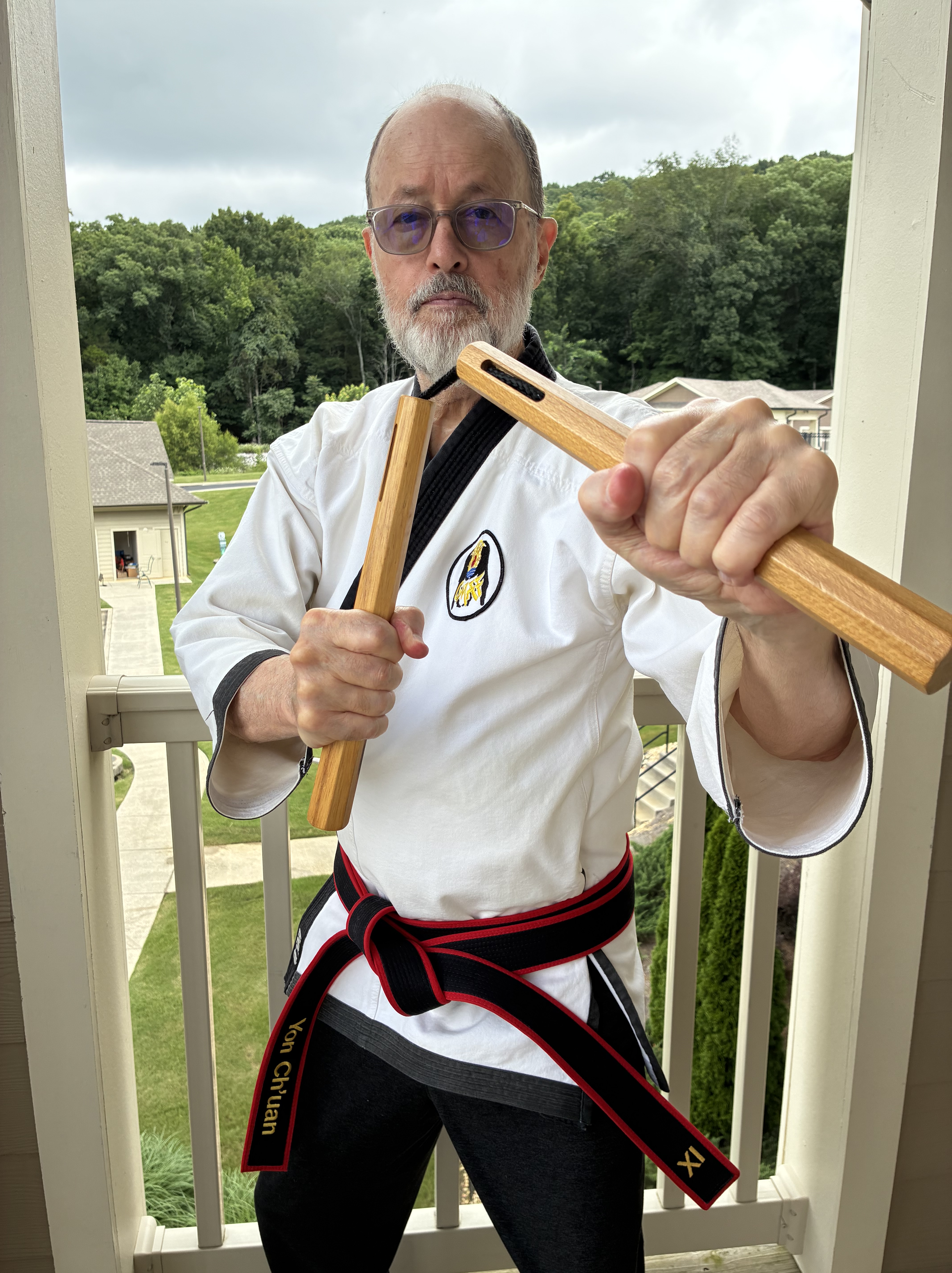
Nunchaku are also known as ‘chain-connected sticks.’ My earliest Nunchakus were connected with a nylon cord. I later purchased ones connected with a metal chain.
The martial art is called Nunchakujutsu and is well-known because of its use in many martial arts movies. The weapon can be used at close and medium ranges to block, parry, trap, grapple, choke, thrust, and strike. It’s quite effective at dealing with an opponent using a variety of weapons (e.g. knife, stick, sword).
I was taught as a teenager that Nunchakus came from Okinawa and were used by farmers and other commoners to protect themselves after Japanese Samurai took away their sharp weapons in the 17th century. I was also told that members of the aristocracy in Okinawa also used Nunchaku for personal self defense.
I later learned China may have had a similar type of weapon centuries earlier, and that the Okinawan martial artists who trained in China brought the idea back to Okinawa. Some historians believe the name derived from a Min Chinese name for a ‘two-section stick.’ The word ‘Nun’ may refer to the rope, cord, or chain that connected the ‘chaku’ (wooden handles).
I also found a 10th century Chinese military document called ‘Wujing Zongyao‘ that mentioned two sticks that were connected by a metal chain. The writer mentioned that it was similar in shape to ‘flails’ that farmers used. The sticks were called ‘Xirong.’ Chinese soldiers on horses used the Xirong to strike opponents during battles. They were reportedly quite effective.
Regardless of the truth of the history of Nunchaku, it’s definitely a primary weapon for a martial artist to have in their ‘arsenal’ of traditional weapons. I should mention here that ‘Nunchaku’ are illegal in some countries. Though Nunchaku are legal to possess in most states in the United States, some have laws against ‘concealed carry’ unless you have a ‘carry permit.’ Be sure to check your state or country laws so you know the legal way to possess and carry Nunchaku.
Though I learned Nunchaku as a teenager with hardwood weapons, I recommend children and teens begin with foam-padded Nunchaku. It’s quite easy when learning to hit yourself in the head, legs, etc., so learning with a padded Nunchaku is a safe and less painful way of learning. Your Sensei will know when you’re ready to move to the wooden version. Some Nunchaku are made of metal, which can be lethal in combat.
Pierre Mercier won 1st Place in the World Nunchaku Championship in 2012. His performance shows the many ways the weapon can be used effectively.
I made a series of short videos about 20 years ago for the purpose of demonstrating how to use various weapons for cardio and joint flexibility, especially for people in their 40s, 50s, and 60s. Here’s the video I made for Nunchuku. Keep in mind that I’m demonstrating exercises for cardio and flexibility rather than specific uses of the Nunchaku for self defense. However, the video will give you an idea of how to move the weapon.
Next Time
We will look at another traditional Weapon you can study when our special series continues.
[Sensei McGee is a 9th Degree Black Belt in Yon Ch’uan Martial Arts, a Master Instructor in Hwa Yu T’ai Chi Ch’uan, a 7th Degree Black Sash in Shaolin Kung Fu, and a 3rd Degree Black Belt in Matsumura Seito Shorin Ryu Karate. Sensei McGee also has Black Belts in several other styles of martial arts.]
[Join our Grace Martial Arts Facebook Community!]
Grace Martial Arts © 1990 – 2026


2 Comments