
The purpose of this series is to help you choose for yourself or your child one or more traditional martial arts weapons that will assist in developing an understanding of this ancient system of self defense. Learning a new weapon is also part of preparing for your Black Belt test.
If you are currently studying with a martial arts instructor, he or she will guide you to the weapon(s) that are best for your style. If you are not currently studying with an instructor, we hope this series will help you in your selection.
My first recommendation is the Yawara stick, also known as a “palm” stick because it fits neatly in the palm of your hand. My next recommendations is ‘Escrima sticks.’ The third basic weapon I recommend is the Nunchaku. The fourth is the Tonfa.
Tonfa
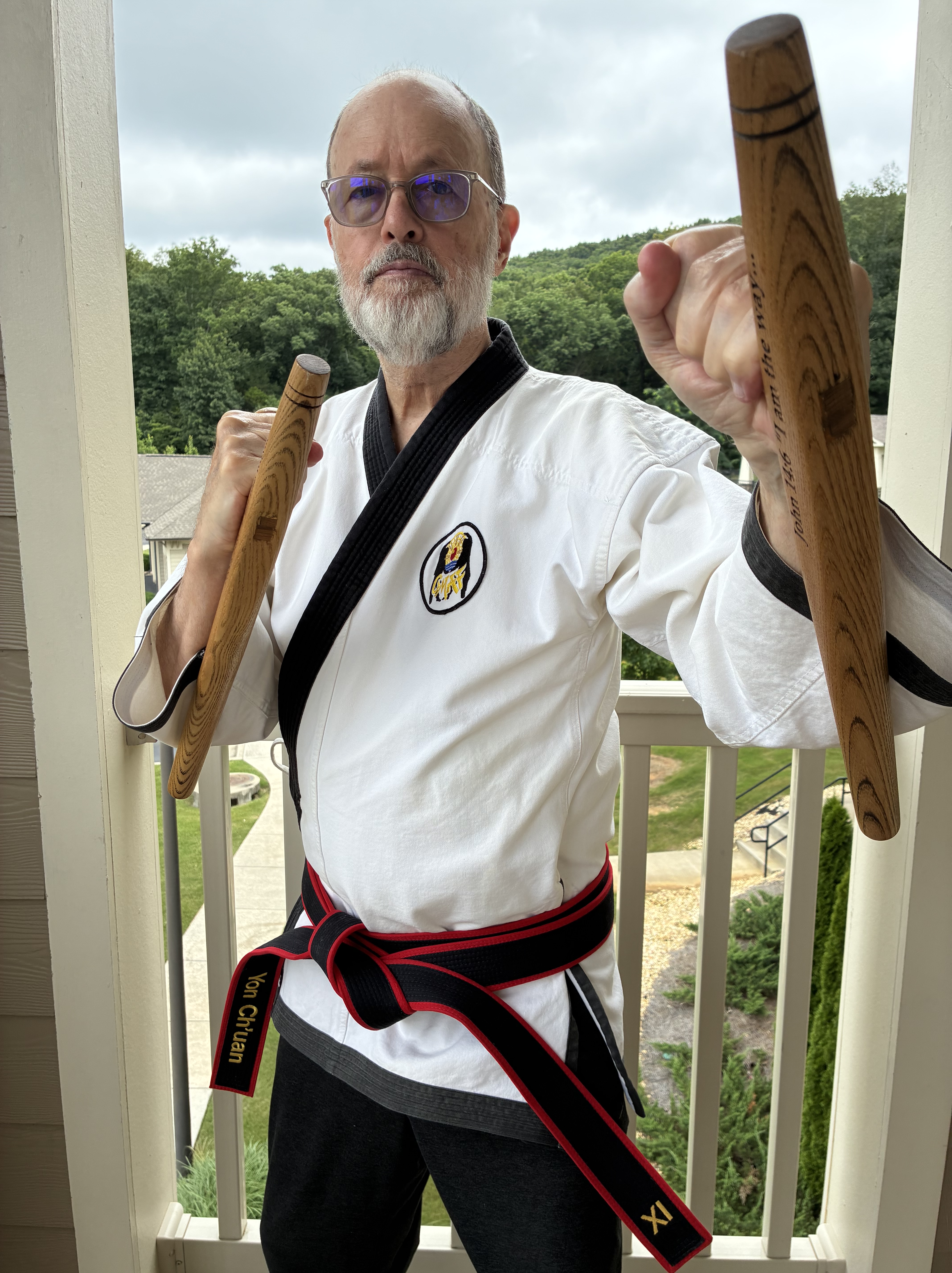
Tonfa jitsu (also known as Tonfa-jutsu) is part of Okinawan Kobudo. As with other Kobudo weapons, Tonfa likely originated as a tool in Okinawan agriculture – possibly as the handle for a millstone. Tonfa are made from hardwoods (e.g. oak, hickory, rosewood, beech). Training versions of the Tonfa include foam, polypropylene, or PVC.
As with other Okinawan weapons, some martial arts historians believe the Tonfa originated in China and was brought to Okinawa by martial arts masters who trained in China.
The Tonfa is a 15-20 inch piece of wood with a short perpendicular handle. We use them in pairs to defend against multiple opponents and weapon attacks (e.g. knife, sticks, sword). It is also known as a ‘melee’ weapon for close-range combat or defense.
Gripping the handle with the length of wood pressed against the arm allows for solid blocks and elbow strikes. The front ends of the wood are excellent for striking an opponent at close range. That type of strike can break ribs and puncture lungs, so be careful when using them with a partner.
If you loosen the press against your arm slightly, you can ‘swing’ the weapon to strike or block, or use the length of the wood to jab an opponent in the head, face, neck, or chest. Swinging the tonfa at someone’s head can cause a severe concussion, so again be careful when training with a partner. The Tonfa is an extremely effective weapon in the hands of an expert.
We use three primary grips in Tonfa jitsu:
- Natural grip (honte-mochi)
- Reverse grip (gyakute-mochi)
- Special grip (tokushu-mochi)
Martial artists new to the Tonfa often use foam-padded weapons so they or their partners are not injured during training. Senseis will move them from foam to wood when they believe students are ready to wield the real weapon. Early training with a wooden Tonfa may include striking a heavy bag to get the feel of striking an object that does not move easily. It also helps the student practice a variety of straight strikes, blocks, and swinging strikes as hard as they want without fear of hurting a partner.
Today, law enforcement officers across the world use a modern version of the Tonfa (e.g. Police Baton, PR-24) for subduing suspects and controlling crowds.
This short video demonstrates how the Tonfa is effective against longer weapons.
Next Time
We will look at another traditional Weapon you can study when our special series continues.
[Sensei McGee is a 9th Degree Black Belt in Yon Ch’uan Martial Arts, a Master Instructor in Hwa Yu T’ai Chi Ch’uan, a 7th Degree Black Sash in Shaolin Kung Fu, and a 3rd Degree Black Belt in Matsumura Seito Shorin Ryu Karate. Sensei McGee also has Black Belts in Tang Soo Do, Taekwondo, and Kempo.]
[Join our Grace Martial Arts Facebook Community!]
Grace Martial Arts © 1990 – 2026


