
I’d like to share a special story with you as we continue our series on ‘Protecting the Vulnerable.’
I’ve had the opportunity of teaching scores of families through the years. It’s always been a highlight to teach moms, dads, and their kids together. It’s a great family experience, in addition to learning martial arts in a Christian environment.
One of these families has three sons who all became Black Belts and assistant instructors in Yon Ch’uan. They have a special love for the Deaf and took their love and concern to Columbia, South America several years ago to share self defense and the Gospel of Jesus Christ.
I asked Jonathan Edgar, who is an assistant instructor in our Lutz, Florida Grace Martial Arts school, to share his memories of that time as part of this series on teaching the Deaf how to defend themselves against a physical attack.

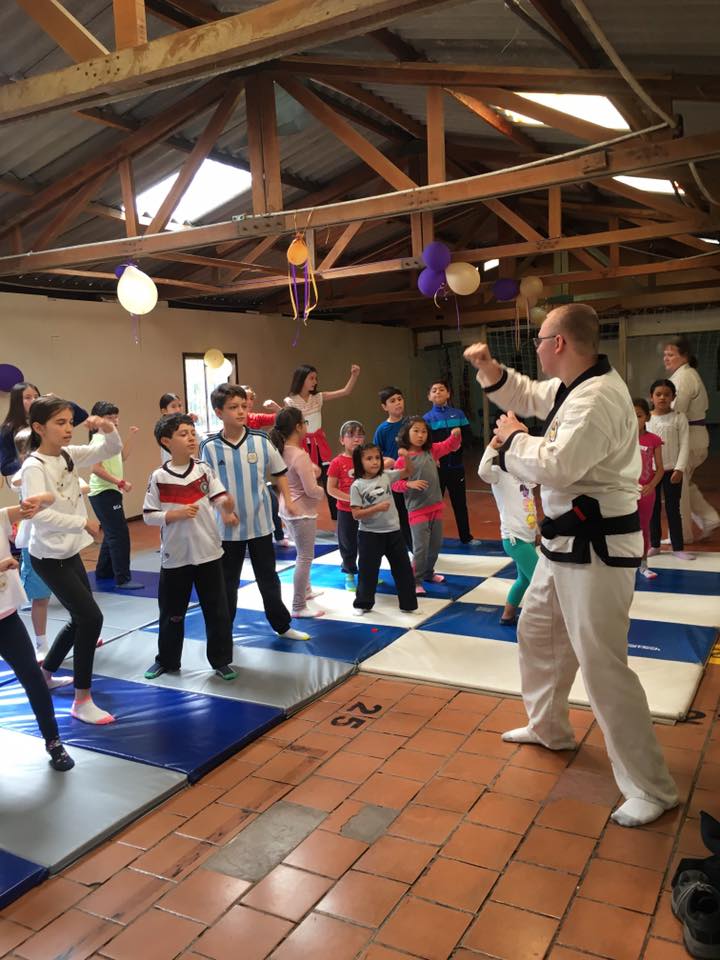
In 2017, my brothers and I went on a mission’s trip together with Deaf Missions International, an organization focused on providing underprivileged Deaf individuals access to health, education, and the Holy Scriptures. DMI invited us to Bogota, Colombia to teach self-defense to the Deaf people there. While most aspects of self-defense are the same for hearing people or Deaf people, there were a few specific concepts we felt required greater emphasis for the Deaf students.
One thing that we heavily emphasized to the Deaf students was visual awareness of one’s surroundings. Without being able to detect audible warnings, such as footsteps, it’s important to utilize other senses, like sight and touch. Looking out for suspicious or dangerous activity, and being able to react quickly when you feel an attack are both crucial to avoiding harm. For many Deaf people who use sign language, this skill will actually come much more naturally to them. Sign language requires training one’s peripheral vision to be able to see someone’s signs while looking at their face. While the concept of situational awareness remains the same for anyone, our time in Colombia proved that there are various ways that awareness can take form depending on a person’s specific capabilities.
Another important self-defense tactic for Deaf people is their voice. Since most Deaf people don’t often use their voice, they may not always consider the importance of it in a self-defense situation. Furthermore, it can be difficult for a Deaf person to know what it means to shout “loudly,” because the concept of volume is inherently linked to hearing. It is essential when teaching a Deaf person
self-defense that you teach them to shout as loudly as they can to both disorient the opponent and potentially alert someone nearby to the situation.
Overall, self-defense for a Deaf person is conceptually the same: Staying aware of your surroundings, being able to react quickly to threats, and knowing how to efficiently create an opening for escape. As such, most of our time in Colombia was focused on the same techniques we used in our normal classes. But beyond that, it’s important to consider one’s individual strengths and weaknesses. In the case of teaching Deaf people, the focus should be on watching one’s surroundings, using voice, and avoiding potential attacks.”

As an additional note, you may notice that I use “Deaf” with a capital “D.” Within the Deaf community, people make a distinction between “deaf” and “Deaf,” with lowercase deaf just meaning someone who cannot hear, or is severely hard of hearing, while capital Deaf refers to people who are “culturally Deaf.” This mostly applies to people who don’t view their Deafness as a disability, but rather as their identity. While there is technically a difference in the two terms, most people use them interchangeably. I personally choose to always write capital “Deaf” to be sensitive to people who take great pride in their Deaf Identity.

Also, I want to remind you that there’s a Facebook group called DMI Colombia Project Self Defense Edgar Family that has some pictures and other details about our trip in case you want to check that out.
– Jonathan
Thank you, Jonathan!
We’ll look at how self-defense teachers can ‘teach’ themselves to be better teachers for their deaf students in the next part of our special series.
[Join our Grace Martial Arts Facebook Community!]
© Grace Martial Arts 1990 – 2024

 Grace Martial Arts