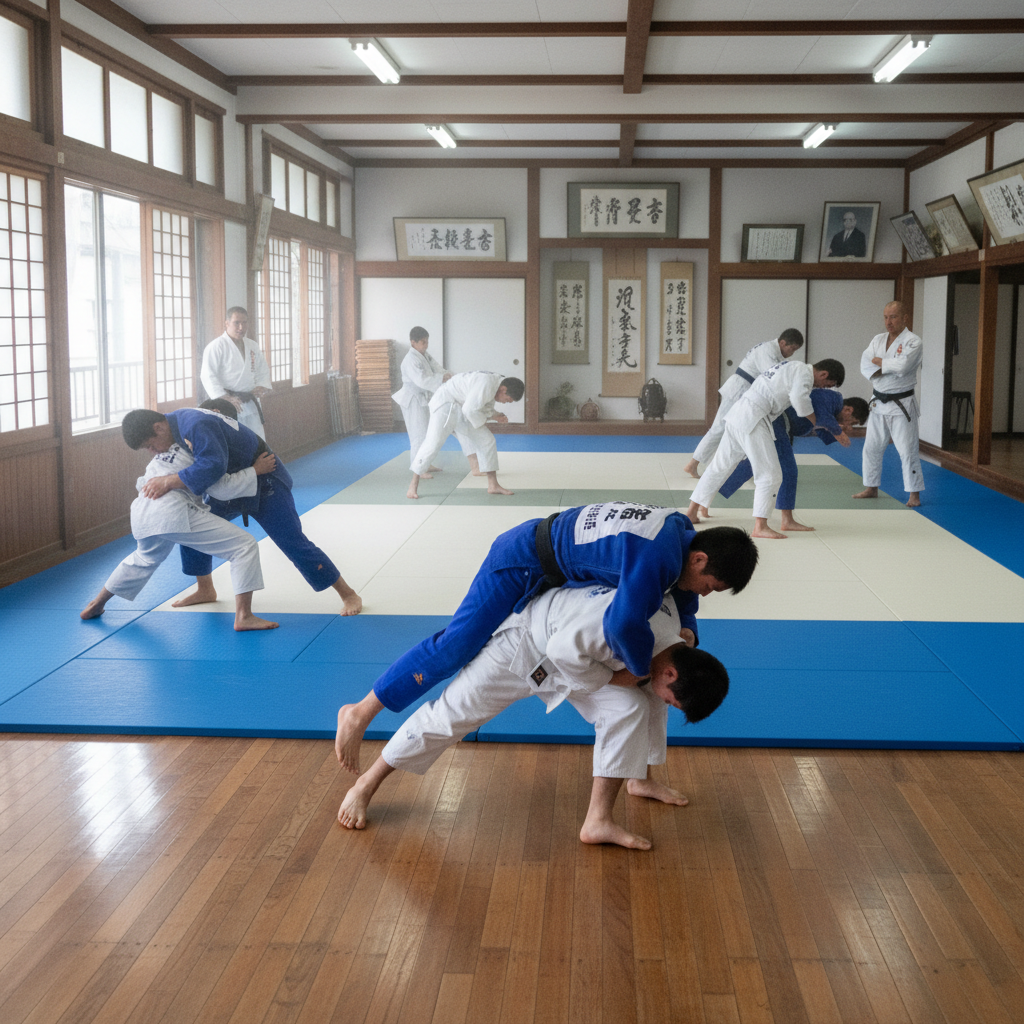
The picture above reminds me of the first Dojo where I trained in 1961. The Sensei stood by watching the class closely. One of his Black Belts also stood watching, ready to step in and correct a student’s stance or throw. One difference was that we did not have Judo ‘mats’ 65 years ago. One of the dojos I trained in had wooden floors. All of the lower-ranked belts had the responsibility to clean the floor before and after practice. We would kneel next to each other with a towel in our hands. Upon the command from Sensei or a sempai, we would all push the towels across the dojo floor. When we reached the end of the floor, we would turn around in unison and push the towels back across the floor. We would then stand at attention and wait for Sensei to approve or disapprove of what we had done. If he disapproved, we would repeat the cleaning.
Many of the American instructors in the 1960s were former military who had undergone serious training in Japan. Respect and discipline were most important in Judo training, as was true in training in other martial arts at the time (e.g. Aikido, Karate, Kung Fu). I found the rigid and demanding training exhilarating as a twelve year old boy. I also played other sports at the time (e.g. baseball, swimming, diving), but Judo was different than anything else I had ever experienced. Needless to say, I fell in love with Judo and martial arts. Though the word ‘Judo’ is usually defined as the ‘Gentle Way,’ I quickly learned how fast and devastating it can be in practice, testing, competition, and self defense.
Dr. Jigoro Kano developed Kodokan Judo in 1882 during the Meiji Period. Judo came from traditional jujutsu, but took out many of the techniques that would seriously injure an opponent. The word Judo means ‘flexible, yielding.’ Though it has come to be defined as the ‘Gentle Way,’ anyone who has practiced it for several months knows that it is anything but ‘gentle.’
The following video is an example of what I mean. Notice how quickly, powerfully, and fluidly the older Judoka moved. How many throws and grappling techniques do you recognize?
I never dreamed as a child that I would one day be writing from the position of having been a student of Judo and other martial arts for 65 years and an instructor for 62. I also never dreamed that I would teach martial arts from a Christian perspective. Though I was raised by parents who were Christians, I only went along to get along. I didn’t believe in God and later became an atheist. Thanks to God’s love and mercy, I became a Christian in 1971. I joined Judo and Karate for Christ a year later and learned how to present the Gospel message while demonstrating martial arts. We changed the name of the organization to Karate for Christ International (KFCI) in 1998. I also became involved with other Christian martial groups, like Christian Black Belts Association (CBBA), that focus on teaching a variety of martial arts from a Christian perspective. I am thankful for the opportunities God has given me as a Christian martial arts instructor these last 55 years.
Judo Training and Terminology
We are focusing on Judo this semester in our Grace Martial Arts classes in Lutz, Florida (Tampa Bay area), so I’d like to share some training and terminology notes with you. I use some of them during classes, so I thought it might be helpful for you to have access to them in a printed form. The throwing requirements for each rank are published in your Yon Ch’uan Martial Arts Black Belt Study Guide With Scriptures, so I’ll focus on Judo principles rather than specific throws.
Let me begin with the ideas of ‘discipline’ and ‘respect.’ The word ‘discipline’ in Judo is Budo and refers to the ‘martial way.’ The idea is of the ‘discipline’ of martial arts. The word ‘respect’ in Judo (and other Japanese martial arts) is Rei. We always want to demonstrate respect to our instructors, fellow students, and the art we study. It is proper to bow at the waist when approaching an instructor or someone of higher rank. We also bow to our partner before and after training or competition. I was taught to bow in respect when entering and leaving the dojo. Bowing has nothing to do with ‘worshipping’ another individual or a martial art in Christian martial arts. It is simply a sign of showing respect and demonstrating gratitude toward our fellow Judoka (Judo practitioners).
Hajime is the word your Sensei will use as a signal to begin working with your partner. When you hear Sensei say Matte, stop immediately and turn to face Sensei. He will watch to make sure everyone is safe and practicing properly. He may see something that would be helpful to the entire class, point out some movements that have the potential for injury, or to move the class to the next technique.
We use the term Uke and Tori during class. Uke is the Judoka who ‘receives’ a technique. As an Uke you want to help yourself and your partner by falling (Ukemi – breaking forward, backward, and side falls .. also learning how to roll over our shoulder to a standing position) correctly and moving smoothly so that your partner improves in their ability. The partner of an Uke is known as a Tori. The Tori is the Judoka who performs the technique. The Tori should focus on moving exactly as the Sensei teaches them. I can think of at least three reasons why:
- Safety
- Correct movment
- Being able to pass the art along to your own students in years to come
The word Waza means ‘technique.’ We have eight basic Wazas in Judo:
- Nage-waza – general term for throwing techniques
- Tachi-waza – general term for standing techniques
- Sutemi-waza – general term for sacrifice throws
- Ashi-waza – Leg and foot techniques
- Koshi-waza – Hip throws (though many hip throws use the word Goshi, the proper name for the waza itself is Koshi)
- Te-waza – Hand and arm throws
- Katame-waza – groundwork – these include Osae-komi-waza (pinning your opponent until they submit), Shime-waza (choking or strangling your opponent until they submit), and Kansetsu-waza (locking your opponent’s joints until they submit)
- Atemi-waza – striking techniques, including (not allowed in competition, but taught as part of original Judo and for self defense)
Just a quick note about Shime-waza. We usually do not allow ‘choke holds’ when practicing Yon Ch’uan. That can lead to serious injuries which can require immediate medical attention. Traditional Judo instructors and referees learn a system of resuscitation known as Kappo. While that is helpful to know as an instructor, modern medical interventions (e.g. CPR, certified first aid) are usually preferred in less traditional training settings.
Tai sabaki is very important in Judo, Aikido, Jujitsu (also spelled Jujutsu), Karate, Kung Fu, Kempo, and other martial arts. It means ‘body management, body control’. Once you learn how to manage/control your own body, you will be able to better manage your partner or opponent’s physical movements.
The movement of feet within Tai sabaki is known as Shintai. That pertains to the movement of the body forward, backward, to the side, or turning in any direction.
Grand Master John Chung Li (GM Xavier’s teacher) used to say that ‘relax’ is the secret word in T’ai Chi. The Chinese word is Sung. It means much more than just to relax the body as in standing or sitting without any specific focus or attention. The body is relaxed, loose, and stretched out so there is no stiffness in the joints. GM Li used to say, ‘Slow Makes Fast.’ The student learns how to move through the technique slowly at first to ensure that their movements are correct. The movements become lightning fast later as the student makes progress. However, the idea of moving quickly from a relaxed posture (Shisei) does not change. The Tori remains relaxed throughout the technique no matter the speed. GM Li also used the term ‘move from the natural’ when describing how to move in Hwa Yu T’ai Chi Ch’uan.
A similar idea in Judo is known as Shizentai. That’s a relaxed but alert stance that come from a ‘natural posture.’ Your body should be upright and relaxed, but always ready to ‘spring’ into action. Your movements in Judo will be much faster when you understand Shizentai and Sung.
Throwing in Judo has three basic principles:
- Kuzushi – breaking opponent’s balance, unbalancing opponent, disturbing balance
- Tsukuri – entering, fitting in, preparatory acton for attack
- Kake – execution of the throw, attack
While many Judoka think of Kake as being the most important aspect of Judo training, it is simply the result of excellent Kuzushi and Tsukuri skills. The training process I remember as a child and teenager included four steps. Each one was done in succession with the approval of Sensei or a senior Sempai.
- Proper gripping
- Kuzushi
- Tsukuri
- Kake
We had already spent months learning how to do a ‘breakfalls’ (Ukemi – also spelled Uke-mi), so we were allowed to finish Kake once Sensei approved of our progress with the previous steps. Each partner would go through the four steps one at a time for every throw in the beginning. Once Sensei said we were ready, we were allowed to move through all four steps in one fluid motion. If Sensei was not satisfied with our progress, we would revert back to the step-by-step process until he was satisfied.
A phrase we use in martial arts is ‘teach large, train small.’ What that means is the Sensei teaches movements in a ‘large’ manner so that everyone in the class can see what he or she is demonstrating. The ultimate goal is to practice to the point that the movements are small and quick. When you watch a video of high-ranking Judoka, you may not even notice they they are off-balancing an opponent, but it’s there. They learned Kuzushi large and trained small. The same is true with Tsukuri and Kake – ‘teach large, train small.’ That’s why Judo throws are so fast and dynamic at the higher ranks.
I was taught to off-balance, enter, and execute in eight directions. Timing and aiming are very important to developing excellence in Judo and other martial arts. Kuzushi might pull or push, depending on the opponent’s movements and intent. One of the reasons there are so many different throws in Judo is so you can blend with your opponent’s intent and take them where they want to go – just not the way they want to go. Moving from a relaxed posture (Shizentai) means you don’t need to use strength to defeat an opponent – even a much larger and more powerful opponent.
‘Grip’ Training
Next, I want to move to how to ‘grip’ your partner or opponent. The Japanese word for ‘grip’ is Kumi kata and means ‘assemble/build method.’ This is the strategy of how to grab an opponent and grip their clothing. The idea of Kumi kata is to ‘control’ your opponent (or partner). It’s sometimes referred to as ‘grip fighting.’ You’ll see that in Judo matches when opponents approach each other and look for ways to strategically ‘grab and grip’ their opponent’s Gi (uniform). Gripping your opponent is how you can begin the process of off-balancing and controlling them, while keeping them from doing the same to you.
We use two primary grips in Judo: Ai yotsu (same-side grips) and Kenka yotsu (opposite-side grips). We begin the training process for learning how to grip in a position known as Randori (‘free exercise). That’s a safe way to begin learning how to grip, off-balance, enter, and throw. We use Yakusoku geiko (‘prearranged, compliant practice) in our classes because everyone knows who is throwing and what throw will be used during practice. The Uke does not attempt to resist the Tori in this kind of training. The Uke cooperates so that the Tori learns how to throw. Eventually, Randori turns into competitive freestyle matches known as shiai – similar to what you see in Olympic Judo.
The way we learn to grip in training is to face our partner about four feet from each other. Bow to show respect, then step toward each other. Tori and Uke grip each other’s sleeve at the elbow joint with one hand. That hand is known as Hikite (pulling hand) and is important in every aspect of Yon Ch’uan. Learning how to use the pulling/return hand works for Judo, Karate, Aikido, and Kung Fu. Tori and Uke also grip each other’s high lapel (just below the collarbone) with the ‘lifting hand’ (Tsurite). The combination of the sleeve and collar grip (pulling and lifting) allows you to control each other’s movements. It’s part of ‘body management’ (Tai sabaki).
In a real Judo match or self-defense situation you do not want your opponent to get a usable grip on you. If you feel that your opponent has a usable grip on you, immediately ‘break’ his or her grip. You can do that by controlling the lapel, neutralizing their arm, or stripping their sleeve. Always be sure to protect your dominant (power) hand because losing control of that hand often leads to your being thrown. Training to do that includes developing more strength in your hands and arms. I was taught to do that by using an Obi (usually unused white belt) to ‘wring’ like a wash rag. I also placed the belt around a tree, post or metal bar and pulled with both hands in opposite directions. That will develop forearm, wrist, and hand strength over time.
We emphasize the motions of ‘push/pull’ in most aspects of Yon Ch’uan. You can use your grip to feel your opponent’s ‘intent’ and move in a way that uses their strength against them. For those of you who used to train with me in Iaido and Iaijutsu years ago will probably remember my emphasis on the three-finger grip to maintain power while keeping your wrist flexible. The same is true in Judo gripping.
Here are two of Jigaro Kano’s primary principles for training in Judo:
Seiryoku-Zenyo – maximum efficient use of energy
Jita-Kyoei – mutual welfare and benefit
Those are some of the primary principles of Judo. I’m so glad you are in Grace Martial Arts and pray that your experience is both fun and helpful to you.
In Christ’s Love and Grace,
Sensei Mark McGee
Taking God’s Grace to the World!
[Join our Grace Martial Arts Facebook Community!]
Grace Martial Arts © 1990 – 2026
 Grace Martial Arts